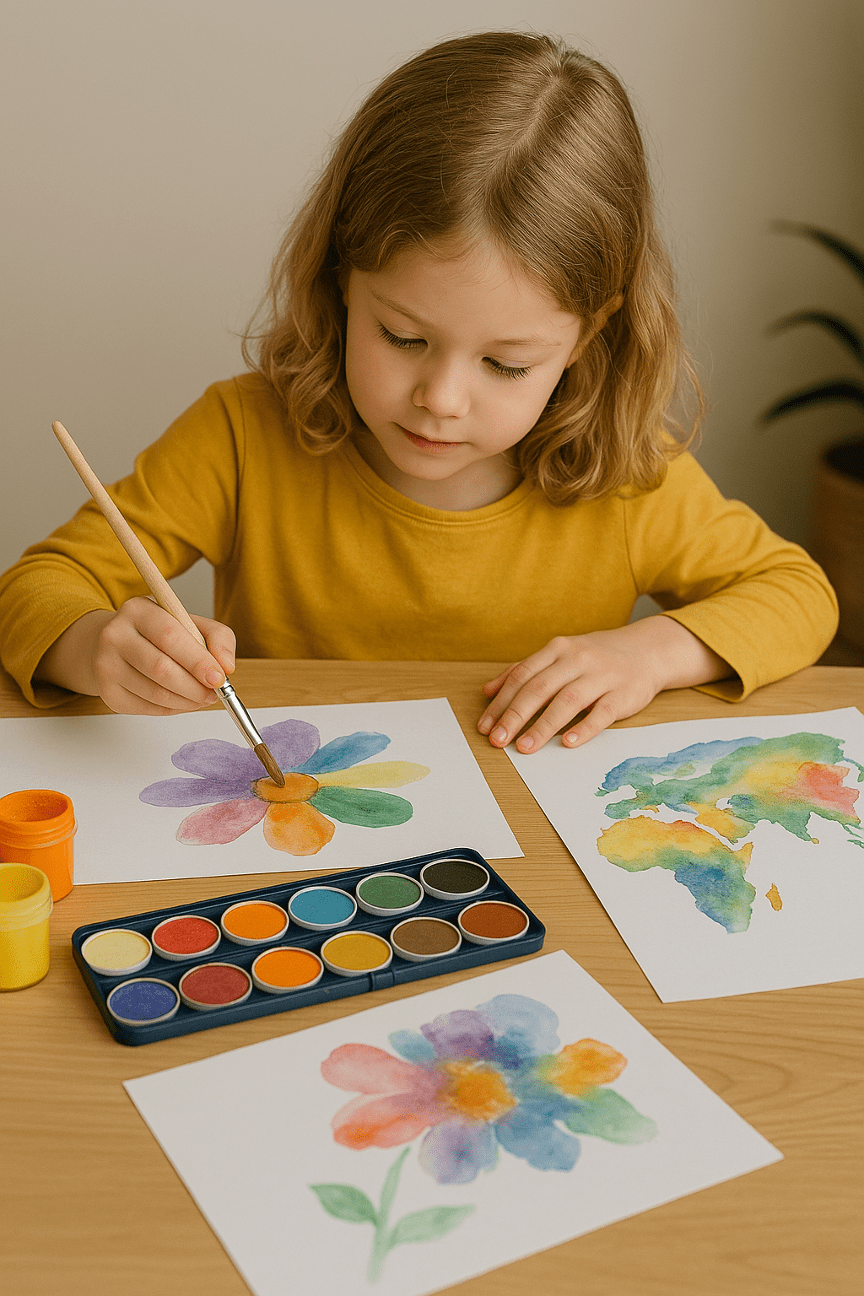
When most people think of art in homeschooling, they often imagine painting, drawing, or crafting—usually reserved for free time or “fun Fridays.” However, art is not just a recreational activity; it is a transformative tool for learning. For homeschooling parents, integrating art into everyday lessons can make education more engaging, memorable, and effective across all subjects.
In this article, we’ll explore the importance of using art as a means to teach your children, show how it can illuminate understanding in diverse academic areas, and offer hands-on and visual strategies for incorporating it into your homeschool curriculum.
Why Art Belongs at the Center of Homeschooling
1. Art Enhances Cognitive Development
Studies show that art engages both hemispheres of the brain. It supports problem-solving, improves memory retention, and encourages critical thinking. When children create or analyze visual representations, they develop spatial reasoning and fine motor skills—skills crucial for subjects like math and science.
2. Art Makes Abstract Concepts Concrete
Whether it’s using clay to mold a topographical map or illustrating a cell diagram, art makes abstract or complex concepts more accessible. Visual learners in particular benefit from associating ideas with images and patterns.
3. Art Fosters Emotional Expression and Confidence
Children who struggle with traditional instruction often shine when given artistic freedom. Art allows them to express understanding in a non-verbal format, which builds self-esteem and offers an alternative channel for comprehension and communication.
4. Art Is a Gateway to Multisensory Learning
Hands-on, visual, and kinesthetic learners benefit immensely from multisensory instruction. Integrating art into lessons allows for a more dynamic learning experience that appeals to various learning styles.
Integrating Art Across the Curriculum
Here’s how art can be a powerful teaching tool across different academic subjects:
1. Language Arts: Visual Storytelling and Literary Interpretation
Art Strategy: Story Boards and Character Design
Visual storytelling helps children break down plot structure, comprehend character development, and retain literary themes. For example, after reading a novel, your child can create a graphic novel version of a chapter or sketch key characters and settings. This helps with recall and interpretation.
Activity Ideas:
- Illustrate vocabulary words.
- Create dioramas of literary scenes.
- Design a book cover and write an artistic review from the character’s point of view.
- Use collage to explore metaphor and symbolism in poetry.
2. Science: From Cell Diagrams to Ecosystems
Art Strategy: Scientific Illustration and 3D Modeling
Science is full of visual elements that lend themselves to artistic interpretation. Drawing the parts of a flower, crafting DNA models, or painting the solar system can help students internalize scientific information.
Activity Ideas:
- Make a 3D model of the human body using craft materials.
- Design a “zine” (mini-magazine) on the water cycle.
- Use watercolor to depict cloud formations or the layers of the Earth.
- Build an insect with pipe cleaners and identify its anatomy.
3. Math: Visualizing Numbers and Patterns
Art Strategy: Geometry Through Design and Number Art
Math becomes approachable when it’s paired with visual and tactile projects. Symmetry, fractions, ratios, and measurement can be creatively taught through visual mediums.
Activity Ideas:
- Create a mandala using geometric shapes to explore symmetry.
- Use origami to understand angles and fractions.
- Design tessellations like M.C. Escher to study pattern and repetition.
- Paint math fact murals (e.g., multiplication arrays or Fibonacci spirals).
4. History: Time Travel Through Artistic Recreation
Art Strategy: Cultural Art and Historical Reconstruction
Recreating the art and artifacts of a particular time period helps students connect emotionally and intellectually with the past. Art makes history feel alive and personal.
Activity Ideas:
- Recreate cave paintings with charcoal and natural pigments.
- Build cardboard models of ancient architecture like the Parthenon or Egyptian pyramids.
- Design and decorate a medieval coat of arms.
- Host a “living history” art exhibit where students dress in period costumes and explain their artwork.
5. Geography: Mapping with Color and Texture
Art Strategy: Illustrated Maps and Cultural Exploration
Geography becomes an immersive experience when students create their own maps or study the artistic traditions of different cultures.
Activity Ideas:
- Paint a relief map with salt dough and label topography with flags.
- Create postcards from different countries including native designs or landmarks.
- Use textiles to study patterns in global cultures (e.g., African Kente cloth or Japanese sashiko).
- Make a travel journal featuring sketches and watercolor maps of each continent.
Practical Tips for Homeschool Parents
You don’t need to be an artist or have a studio to incorporate art into learning. Here are some practical tips to make it manageable and fun:
1. Start Small
Begin with one art-integrated activity per week. Choose a subject your child loves and find a simple project that blends with the topic.
2. Use What You Have
No need to invest in expensive supplies. Everyday materials like newspaper, cardboard, glue, markers, and recyclables work wonderfully.
3. Create an “Art Box”
Fill a bin with rotating supplies—paints, colored pencils, scissors, stencils, clay, etc.—so art is always accessible.
4. Display Their Work
Create a gallery wall or art portfolio. When children see their work showcased, they take more pride in their learning.
5. Incorporate Digital Art Tools
Apps like Procreate, Canva, or Tayasui Sketches offer digital options for creating storyboards, animations, or infographic reports.
Addressing Common Concerns
“My child isn’t artistic.”
Art isn’t about perfection—it’s about process and exploration. Encourage creativity without focusing on the final product. The goal is to deepen understanding, not to create a masterpiece.
“Art feels like an extra chore.”
Instead of making art a separate subject, blend it into what you’re already doing. For example, turn a history assignment into a poster project, or use clay to model math equations.
“We’re on a tight schedule.”
Integrating art doesn’t have to take hours. Quick sketching, journaling, or 15-minute crafts can reinforce a concept efficiently and memorably.
Final Thoughts: Art is Not an Extra—It’s Essential
Art is more than a creative outlet—it’s a bridge to deeper understanding, a tool for expression, and a catalyst for connection across subjects. In a homeschool setting, where learning is deeply personal and adaptable, art offers the flexibility and depth to reach every type of learner.
By intentionally integrating art into your homeschooling approach, you’re not only enriching your child’s academic life but also nurturing their ability to think critically, feel deeply, and express themselves authentically.



 Homeschool Unleashed
Leave a comment