
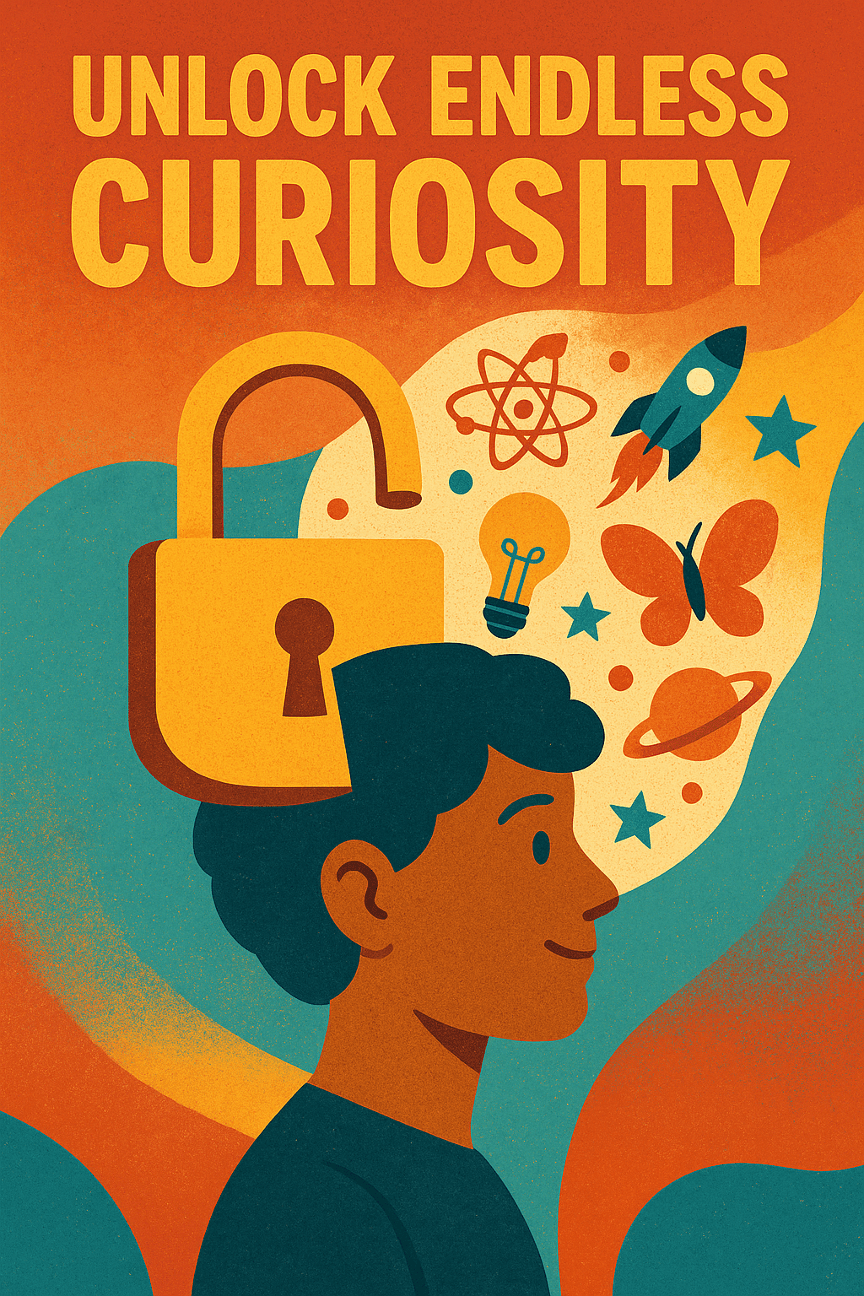
Learn a step-by-step educational strategy to keep learning exciting and new. Spark curiosity, build real-world skills, and use science-backed methods across ages – toddlers to adults.
Why “new” matters: the science of curiosity, novelty, and motivation
Curiosity isn’t fluff – it’s a memory enhancer. When we’re curious, the brain’s reward circuitry (including dopaminergic pathways) “primes” the hippocampus to encode information more deeply. In experiments, people remembered more about topics they were curious about and about incidental facts learned during that curious state.
Equally important is how we revisit what we learn. Two techniques with some of the strongest scientific backing are spaced practice (reviewing in spreading intervals) and retrieval practice (quizzing yourself, not just re-reading). Large reviews and meta-analyses consistently find that spacing and retrieval outperform cramming.
Hands-on, problem-driven learning also boosts outcomes. Active learning (doing, discussing, solving) improves exam performance and lowers failure rates compared with lectures, and project-based learning shows moderate positive effects on achievement, thinking skills, and attitudes.
Finally, lifelong learning builds cognitive reserve, the brain’s resilience against age-related decline; more education and mentally challenging activities correlate with a lower risk of dementia and stronger memory in older adulthood.
Bottom line: Keep novelty high, revisit material smartly, make learning active, and never stop learning.
The SPARK Framework: A simple plan to keep learning fresh
Use this 5-step loop weekly or monthly. It works for individuals, families, co-ops, and mixed-age homeschools.
- Scan interests & goals
Do a 10-minute interest check: “What are you curious about right now?” Keep a living list by person. Align with quarterly goals (skills, credits, portfolio pieces).
- Plan one “anchor project” + two “spark activities”
- Anchor project (3–6 weeks): A real problem or product (e.g., build a weather station, write & record a mini-podcast series, design a micro-business).
- Spark activities (30–60 min): Bite-size novelty bursts that rotate domains (science demo, poetry slam, map-making, kitchen chemistry).
- Active learning & autonomy
Structure each session with doing at the core (experiments, creations, debates). Offer meaningful choice (which topic, product format, tools), because autonomy support reliably strengthens motivation.
- Retrieve & revisit
- 3-question exit tickets
- Weekly low-stakes quizzes or flashcards
- Spaced reviews at +1 day, +1 week, +1 month
These raise retention more than re-reading notes.
- Kaleidoscope the context
Change the setting (outdoors, makerspace, library, museum), rotate tools (analog vs. digital), and interleave topics (A-B-A-C) to sharpen discrimination and transfer.
Age-by-age strategies that keep learning exciting
Ages 3–7: Play is the engine of learning
- What to do:
- “Play labs” with loose parts (ramps, tubes, blocks, magnets).
- Story engineering: build characters with clay; act scenes; draw alternative endings.
- Outdoor micro-adventures: leaf classification, sound hunts, cloud journals.
- Why it works: Developmentally appropriate play strengthens executive function, self-regulation, and language—foundations for later academics.
- SPARK in action:
- Anchor: Build a “mini city” from recyclables; add roads (measurement), signs (literacy), and rules (civics).
- Sparks: 15-min oral counting treasure hunt; color-mixing station with droppers.
- Retrieve & Revisit: “What changed when we added a bridge?” (3 oral questions); photo journal revisit next week.
Ages 8–12: Make & explain
- What to do:
- Project-based units: simple robotics, kitchen chemistry cookbook, state-history documentary, “garden math” (area, ratios).
- Teach-backs and student choice boards (pick the product: comic, slide deck, model, short video).
- Why it works: Projects and autonomy amplify engagement and achievement; choice enhances intrinsic motivation and performance.
- SPARK in action:
- Anchor: Design a pollinator garden (research local species, budget, blueprint; plant starter planters).
- Sparks: 30-min map-reading challenge; citizen-science observation on iNaturalist.
- Retrieve & Revisit: Friday “5-question challenge” + flashcards spaced next week and next month.
Ages 13–15: Curiosity to craftsmanship
- What to do:
- Active seminars: student-led Socratic circles, debates, case studies, lab practicums.
- Maker capstones: app prototype, historical escape room, short film with data-driven script.
- Rotate roles (lead, researcher, builder, editor) to build social-emotional skills that also predict academic gains.
- SPARK in action:
- Anchor: “Energy in my community” investigation (measure electricity usage; propose efficiency upgrades; present to a local board).
- Sparks: Media-bias analysis sprint; 45-min statistics mini-lab with real datasets.
- Retrieve & Revisit: Weekly lightning talks + spaced mini-quizzes; interleave algebra with data literacy for transfer.
Ages 16–18: Purpose, portfolios, and real-world audiences
- What to do:
- Pair dual-credit/online courses with authentic deliverables: publish Medium articles, submit to film or science fairs, launch micro-businesses.
- Use active learning structures in study groups: problem sets in pairs, whiteboard proofs, peer instruction. Active learning boosts exam scores (~0.5 SD) and reduces failure risk vs. lecture.
- SPARK in action:
- Anchor: “Community data story” (collect local data, analyze, visualize, present findings to a stakeholder).
- Sparks: Mock grant pitch; 60-min “failure lab” (document mistakes → fixes).
- Retrieve & Revisit: Spiral spaced reviews for SAT/ACT/ASVAB or trade exams using practice-test cycles.
Adults (parents & learners of any age): Model the mindset
- What to do:
- Choose one novel, cognitively demanding skill for 8–12 weeks (photography + editing, quilting with patterns, coding basics, bilingual journaling).
- Share your learning log publicly with your kids (what you tried, what failed, what improved).
- Why it works: Structured engagement with new, challenging skills improves memory and cognitive function in older adults—evidence you can feel.
Build an “Exploration-First” week (sample schedule)
Monday – Launch & Choice (90 minutes)
- 10 min: Interest scan; set “week question.”
- 60 min: Project sprint (hands-on).
- 20 min: Teach-back/exit ticket.
Tuesday – Field & Nature Day (2–3 hours)
- Trail walk, park, museum, library makerspace. Nature exposure restores attention and supports cognitive performance; even short walks help.
Wednesday – Skills & Drills (60–75 minutes)
- Core skills via active learning: math whiteboards, lab station rotations, reading circles.
Thursday – Studio & Autonomy (90 minutes)
- Student-chosen product formats; teacher/parent provides autonomy support (clear goals + choice within structure).
Friday – Retrieval & Reflection (45–60 minutes)
- Low-stakes quizzes/flashcards; 5-minute reflections; schedule spaced reviews at +1 week/+1 month.
Make the learning sticky: five science-backed practices
- Retrieval practice (daily micro-quizzes, oral Q&A, whiteboard problems)
- Replace most re-reading with recalling from memory.
- Spaced practice (1-day, 1-week, 1-month review ladder)
- Short, distributed sessions beat long crams for long-term retention.
- Interleaving (mix topics and problem types)
- Rotate A-B-A-C instead of A-A-A; helps learners spot deeper patterns.
- Project-based cycles
- Real products aimed at real audiences elevate motivation and learning gains.
- Move & play
- Physical activity and playful learning are linked with better executive function and achievement—especially in younger learners.
Subject-area “curiosity menus” (plug-and-play)
STEM
- Reverse-engineer a household device; sketch the mechanism; propose an improvement.
- Build a low-cost weather station or soil-moisture sensor; analyze weekly data.
- Interleave algebra with data-viz challenges using real datasets.
Humanities & Social Sciences
- “History from a single object”: trace provenance, culture, trade routes; record a 5-minute micro-documentary.
- Debate lab: assign roles (historian, economist, ethicist) on a policy case.
Language Arts
- Publish a family zine (op-eds, poems, infographics) each month; rotate editor roles.
- 20-minute daily reading sprint + 5-minute retrieval (summary from memory).
Arts & Maker
- Design a community mural proposal; pitch to a local café/library.
- Compose a short soundtrack for your science video; perform live critique.
Outdoors as a classroom multiplier
Short nature exposures (a walk, a sit-spot journal, even viewing greenery) can replenish directed attention—making the next math or writing block more efficient. Use “green breaks” strategically around demanding tasks.
Motivation that lasts: autonomy, competence, relatedness
Self-Determination Theory (SDT) shows that when learners experience autonomy (choice), competence (visible progress), and relatedness (belonging), motivation deepens. Meta-analytic work indicates that teacher/parent autonomy support predicts students’ need satisfaction and self-determined motivation. Bring this home by offering real choices within clear structures and celebrating incremental skill growth.
Assess what matters (without killing the joy)
- Portfolio over time: Photos, drafts, data sheets, reflections, final products.
- Mastery rubrics: Define “emerging → proficient → expert” in plain language.
- Public audiences: Family showcases, YouTube shorts, medium-sized community presentations—authentic audiences shift effort and care.
Keep feedback fast, kind, specific: one glow (strength), one grow (next step), one plan (exact move for improvement).
Social-emotional skills are academic skills
Program-level research shows that building social-emotional skills correlates with better behavior and academic performance. Group roles, debates, peer feedback, and service projects train these skills in context.
Quick-start templates
1) Weekly SPARK snapshot (print & reuse)
- Scan: This week I’m curious about…
- Plan: Our anchor project deliverable for Friday is…
- Active: What we’ll do on Mon/Wed…
- Retrieve: 3 questions for Friday…
- Kaleidoscope: New setting or tool to try…
2) 30-minute retrieval routine
- 8 min: Silent recall (no notes)
- 10 min: Pair check + fill gaps
- 7 min: Mini-quiz or flashcards
- 5 min: Schedule spaced reviews (+1 day, +1 week, +1 month)
3) Autonomy-support script (for parents/mentors)
- “Here are two goals we must hit.”
- “Pick the product format (poster, video, model) and the tools you’ll use.”
- “Show me your plan for 45 minutes today; I’ll check in at minute 20.”
Frequently asked questions
How do I keep learning exciting for different ages in a single homeschool?
Run one shared anchor theme (e.g., “water”) with tiered products: a preschooler builds a water ramp, an elementary learner graphs rainfall, a teen models watershed flow. Everyone contributes to a family showcase.
How much novelty is too much?
Stability matters. Keep projects stable for 3–6 weeks, but inject weekly novelty via spark activities, new settings, or tools. Use interleaving to rotate sub-skills within that project.
What if a learner resists?
Increase choice (topic or product), shrink the task, and add a public audience. Choice and autonomy support can lift intrinsic motivation and engagement.
How do I balance fun with rigor?
Rigor grows from doing hard things on purpose and from consistent retrieval and spacing. Keep joy in the build; keep discipline in the review cycle.
Final encouragement
Learning stays exciting when curiosity leads, practice is smartly spaced, projects are real, movement and nature reset our attention, and everyone—from toddlers to adults—has a say in how they learn. If you adopt the SPARK loop, you’ll see more focus, better retention, and a homeschool that feels alive.
✨ For more homeschooling tips, strategies, and inspiration, visit HomeschoolUnleashed.com. You can also dive deeper with my book, Homeschool Unleashed: How to Start, Plan, and Thrive in Your Homeschool Journey —your guide to creating an exciting, curiosity-driven education at home. ✨



 Homeschool Unleashed
Leave a comment