
🌟 Brought to you by Homeschool Unleashed 🌟
Introduction
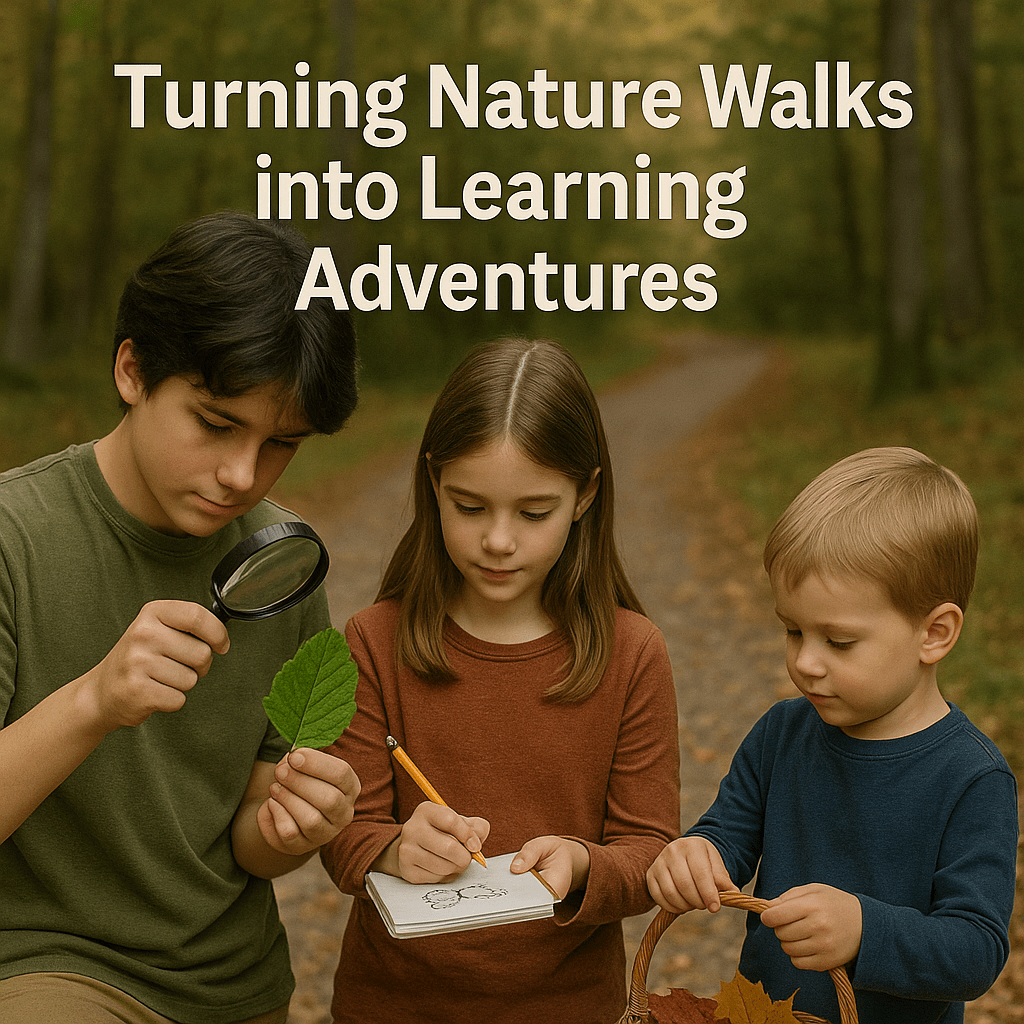
Hiking is more than just a way to get fresh air and exercise—it’s a living classroom. For homeschooling families, a simple hike can become a rich educational experience across age groups, subjects, and skill levels. Whether you’re walking a local trail, exploring a national park, or simply enjoying a nature path in your neighborhood, the outdoors provides endless opportunities to weave in science, math, language arts, art, and even history.
This article explores educational project ideas families can do while hiking, tailored to children of different ages. We’ll also look at follow-up activities across multiple media—books, art, videos, and online research—to bring the learning full circle.
Benefits of Hiking as Education
- Multisensory learning: Children see, hear, touch, and sometimes even smell and taste aspects of nature, which improves retention.
- Hands-on exploration: Learning moves beyond textbooks, encouraging curiosity and critical thinking.
- Adaptable to ages: From toddlers to teenagers, each child can engage at their own developmental level.
- Interdisciplinary connections: A single hike can cover biology, geography, math, writing, art, and physical education all at once.
Ideas for Young Children (Ages 4–7)
1. Leaf and Rock Collection
- Subject Connection: Science, Classification, Early Math
- Encourage your child to collect 3–5 different leaves or rocks along the trail. Discuss the differences in size, color, and texture.
- Learning Opportunity: Sorting and categorization introduce early math skills while building scientific observation.
Follow-up Activity: Press the leaves into a notebook and label them with drawings or photos. Use picture books like Trees, Leaves, and Bark by Diane Burns for identification.
2. Color Scavenger Hunt
- Subject Connection: Art, Observation Skills, Language Arts
- Give children a list of colors and see if they can find natural objects that match.
- Learning Opportunity: Enhances observation, descriptive vocabulary, and creative thinking.
Follow-up Activity: Create a crayon rubbing of textures (tree bark, rocks) and match colors at home with paints or colored pencils.
3. Story Seeds
- Subject Connection: Creative Writing, Language Arts
- Ask them to pick one thing they see on the trail (a bird, a stream, or a flower) and start a story around it.
- Learning Opportunity: Builds narrative skills, imagination, and oral storytelling.
Follow-up Activity: Record their story in a voice memo, then transcribe it into a “hiking storybook.”
Ideas for Elementary Ages (8–11)
4. Trail Map Math
- Subject Connection: Math, Geography
- Show them the trail map and ask: How long is the trail? If each step is about 2 feet, how many steps would it take?
- Learning Opportunity: Real-world application of multiplication, estimation, and measurement.
Follow-up Activity: Have them draw their own map of the hike with landmarks. Transition into lessons about reading topographic maps.
5. Nature Journaling
- Subject Connection: Science, Writing, Art
- Provide each child with a notebook. Encourage them to sketch an animal, plant, or landscape and write 3–5 observations.
- Learning Opportunity: Improves observation, writing detail, and artistic expression.
Follow-up Activity: Compare journal entries over multiple hikes to notice seasonal changes. Create a digital slideshow of drawings.
6. Ecosystem Detective
- Subject Connection: Biology, Environmental Science
- Ask children to observe an ecosystem (e.g., a pond or fallen log). Who lives here? What roles do insects, plants, and animals play?
- Learning Opportunity: Introduces ecology concepts like food chains and interdependence.
Follow-up Activity: Watch a documentary like Planet Earth or research local ecosystems online. Create a “food web poster” at home.
Ideas for Middle School (12–14)
7. Photography as Science & Art
- Subject Connection: Technology, Art, Science
- Encourage older kids to document the hike through photos—focusing on textures, symmetry, or habitats.
- Learning Opportunity: Teaches composition, digital literacy, and observation.
Follow-up Activity: Edit photos with free software (like Canva or Snapseed) and create a digital portfolio or slideshow.
8. Soil and Water Testing
- Subject Connection: Chemistry, Earth Science
- Bring a simple water test kit or soil pH strips. Have your child test samples along the trail.
- Learning Opportunity: Hands-on experiment showing chemistry in the real world.
Follow-up Activity: Compare results with local environmental data. Write a report or create a chart in Excel or Google Sheets.
9. Hiking Poetry Challenge
- Subject Connection: Language Arts, Creative Expression
- Ask them to write a poem inspired by the trail—whether free verse, haiku, or rhymed couplets.
- Learning Opportunity: Builds vocabulary, metaphor use, and emotional connection to nature.
Follow-up Activity: Record them reading their poem and add background hiking sounds for a multimedia project.
Ideas for High School (15–18)
10. Geology in Action
- Subject Connection: Earth Science, Geography
- Identify rock formations, layers, or fossils along the hike. Discuss how landscapes are formed over time.
- Learning Opportunity: Encourages critical thinking about geological history.
Follow-up Activity: Research the trail’s geological past and create a presentation or short video report.
11. Biodiversity Survey
- Subject Connection: Biology, Data Analysis
- Assign older students to list every species they encounter (birds, plants, insects).
- Learning Opportunity: Strengthens classification, data collection, and observational skills.
Follow-up Activity: Input the data into iNaturalist or another citizen science app. This connects them to real-world research.
12. Philosophy Walk
- Subject Connection: Philosophy, History, Language Arts
- On longer hikes, encourage discussions about big questions: “Why do humans explore?” or “What responsibilities do we have to nature?”
- Learning Opportunity: Develops critical thinking, public speaking, and respectful debate.
Follow-up Activity: Have them write an essay or record a video reflection to share with peers.
Cross-Age Group Ideas
Family Storytelling Circle
At a trail rest stop, let each family member add one line to a story. This builds collaboration, creativity, and listening skills.
Mindful Hiking
Practice silence for 5 minutes, then share what everyone noticed. Good for emotional regulation and mindfulness.
Fitness Integration
Have children calculate their steps, heart rate, or calories burned during the hike. Great way to integrate physical education with math.
Bringing the Learning Full Circle: Multi-Media Follow-Up
- Art Integration: Use sketches, paintings, or collages to recreate scenes from the hike.
- Writing Expansion: Turn journal entries into essays, poems, or even blog posts on family learning.
- Digital Projects: Create a family vlog episode, edit a photo journal, or design a slideshow with narration.
- Research Connections: Use the internet to look up unfamiliar plants, animals, or history of the trail.
- STEM Applications: Build simple models—like a diorama of the ecosystem studied or a graph of step counts vs. distance.
Conclusion
Every hike has the potential to become a multidisciplinary homeschool lesson. From toddlers learning colors in leaves to teens exploring geology and philosophy, families can turn nature into a living classroom. The key is to engage curiosity on the trail and then connect experiences to broader learning at home through journaling, art, writing, or technology.
Next time you lace up your hiking boots, remember: the trail isn’t just a path through nature—it’s a path to knowledge, creativity, and lifelong learning.
📌 Homeschool Unleashed Private Consultations
If you’re a parent seeking personalized strategies to build confidence and awareness in your homeschool journey, I offer private consultations tailored to your family’s needs. Together, we can create customized safety awareness lessons, learning strategies, and homeschooling plans to help your children thrive.
Visit HomeschoolUnleashed.com today to learn more and schedule your consultation.



 Homeschool Unleashed
Leave a comment