🌟 Brought to you by Homeschool Unleashed 🌟
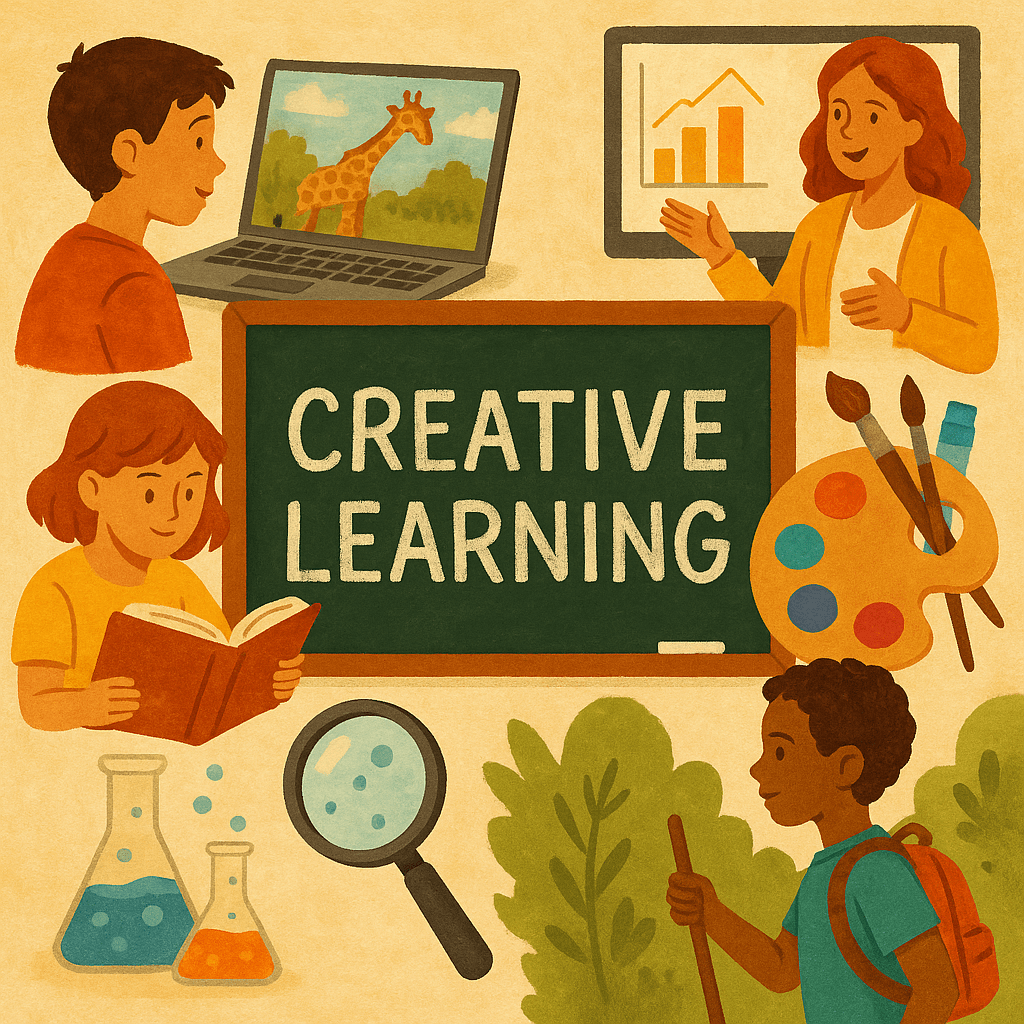
Homeschooling is one of the most customizable forms of education available today. Parents can tailor lessons to their child’s strengths, interests, and learning style. One of the most effective ways to do this is by incorporating different forms of media into the educational routine. From traditional book reading to modern online coursework, the variety of tools at a parent’s disposal is vast and powerful.
In this article, we’ll explore the usefulness of different media in teaching kids, discuss practical ways to weave these into homeschooling, and suggest a flexible routine that maximizes retention and creativity while working around changing schedules and seasons.
Why Diverse Media Matters in Education
Children learn in different ways: some thrive on visuals, others on hands-on experimentation, and many through auditory or kinesthetic engagement. According to the National Center for Biotechnology Information, students exposed to multimodal learning—combining text, visuals, and interactive experiences—show 30% higher retention rates compared to single-mode instruction.
By incorporating diverse media, homeschooling parents can:
- Engage multiple senses to deepen understanding.
- Increase retention through varied input.
- Foster creativity by giving children multiple pathways for exploration.
- Prevent boredom and burnout by changing the learning medium.
Exploring the Different Types of Media in Homeschooling
1. Video Documentaries
Documentaries bring the world to your living room. Whether it’s a National Geographic feature on ecosystems or a history documentary on ancient civilizations, videos provide rich visuals and narratives that make complex topics accessible.
- How to use: Pair a documentary with a project. For example, after watching a documentary about space exploration, ask your child to create a poster of the solar system or write a journal entry from the perspective of an astronaut.
- Subjects best suited: History, geography, science, current events.
- Stat to know: A study from Edutopia notes that students recall 65% of visual content three days later, compared to only 10% of spoken information alone.
2. Online Coursework
The digital age has made structured, self-paced learning more accessible than ever. Platforms like Khan Academy, Outschool, or curriculum-based sites like PowerHomeschool allow children to progress step by step.
- How to use: Incorporate online coursework for math and science, where mastery of sequential steps is essential. Online platforms often require mastery before moving forward, ensuring comprehension.
- Subjects best suited: Math, science, computer coding, foreign languages.
- Stat to know: Research from Education Week shows that students in blended learning environments outperform their peers by 6 percentile points on average.
3. In-Person Instruction
While homeschooling offers independence, face-to-face interaction is still critical. Co-ops, local tutors, or even community classes provide opportunities for socialization and collaborative learning.
- How to use: Join a homeschool co-op for subjects like literature discussions or lab sciences that benefit from group dialogue. Invite guest instructors—artists, scientists, or professionals—for workshops.
- Subjects best suited: Literature, group science labs, performing arts, debate.
- Stat to know: According to the U.S. Department of Education, peer-to-peer learning environments boost motivation and performance by nearly 20%.
4. Physical Book Reading
Books remain the cornerstone of education. Reading builds vocabulary, comprehension, and critical thinking skills. Unlike digital formats, books encourage focus without distractions.
- How to use: Dedicate daily time for reading aloud with younger children and independent reading for older ones. Pair reading with discussion questions or creative retellings.
- Subjects best suited: Literature, history, philosophy, social studies.
- Stat to know: The Journal of Developmental & Behavioral Pediatrics found that daily reading with children improves long-term language development by up to 37%.
5. Artistic Exploration
Art fosters creativity, emotional expression, and problem-solving. From painting and music to drama and design, artistic media allow children to explore abstract thinking in concrete ways.
- How to use: Tie art to academics—paint cells after a biology lesson, or compose a song to memorize historical facts.
- Subjects best suited: Science (diagrams and models), history (timeline illustrations), language arts (theater and poetry).
- Stat to know: Students involved in arts education are four times more likely to be recognized for academic achievement, according to Americans for the Arts.
6. Experimentation
Hands-on experiments bring learning to life, especially in STEM fields. Children retain information better when they manipulate and observe outcomes themselves.
- How to use: Conduct kitchen science experiments (like baking soda volcanoes), build models, or test hypotheses outdoors.
- Subjects best suited: Chemistry, physics, biology, engineering.
- Stat to know: The National Science Teachers Association reports that inquiry-based science experiments improve test scores by an average of 12%.
7. Outdoor Activities
Nature is a classroom without walls. Outdoor exploration provides real-world applications of lessons while boosting mental and physical health.
- How to use: Turn a walk into a biology lesson by identifying plants, use a compass to teach geography, or track weather patterns for earth science.
- Subjects best suited: Environmental science, physical education, geography, biology.
- Stat to know: According to the Children & Nature Network, students who spend time outdoors show increased concentration and a 27% reduction in stress levels.
Weaving Media into Subject Areas
Here’s how parents can combine different types of media for holistic coverage:
- History: Watch a documentary on ancient Egypt → Read a historical novel → Create a pyramid model → Visit a museum exhibit.
- Science: Work through online coursework → Conduct a home experiment → Illustrate findings in an art project → Take a field trip to a science center.
- Language Arts: Read a novel → Discuss themes in a group → Act out a scene → Write an alternative ending.
- Math: Use online coursework → Apply skills in hands-on budgeting projects → Create geometric art → Practice measurement during cooking.
This integration keeps lessons fresh and allows children to approach knowledge from multiple angles.
A Flexible Homeschool Routine Incorporating Media
Every homeschool looks different, but a structured-yet-flexible routine helps parents balance media types:
Sample Weekly Routine
- Monday: Online coursework (math/science in the morning) + book reading (afternoon) + outdoor walk/journaling.
- Tuesday: Video documentary (history or science) + hands-on experiment + art project tied to lesson.
- Wednesday: In-person instruction (co-op or tutoring) + group project + creative writing at home.
- Thursday: Independent book reading + online coursework review + outdoor exploration.
- Friday: Mixed media day—child chooses one medium for a self-directed project. End week with a family discussion circle.
Flexibility tips:
- Use seasons to your advantage—more outdoor activities in spring and summer, more book-based or online work in winter.
- Adjust intensity depending on your child’s mood and needs.
- Rotate the “lead medium” of the day to prevent monotony.
Encouragement for Parents
The beauty of homeschooling is its adaptability. No two days have to look the same, and children thrive when exposed to a blend of experiences. While consistency builds habits, flexibility keeps learning joyful. Remember: the goal isn’t to replicate traditional school but to unlock your child’s natural curiosity.
Final Thoughts
Different forms of media—whether it’s a book, a video, or a nature walk—are like different colors on a painter’s palette. Alone, each has its value, but when blended together, they create a vibrant and memorable masterpiece. By thoughtfully weaving video documentaries, online coursework, in-person instruction, physical reading, art, experiments, and outdoor activities into homeschooling, parents can cultivate lifelong learners who are both knowledgeable and creative.
Homeschooling is a journey, and with the right media tools, it can be one of discovery, inspiration, and endless growth.
✨ For more homeschooling tips, strategies, and inspiration, visit HomeschoolUnleashed.com. You can also dive deeper with my book,Homeschool Unleashed: How to Start, Plan, and Thrive in Your Homeschool Journey —your guide to creating an exciting, curiosity-driven education at home. ✨
✨ Interested in personalized assistance to get started in homeschooling? Homeschool Unleashed also offers hourly consultations to help you every step of the way. Inquire today to start elevating your homeschool success today ✨


 Homeschool Unleashed
Leave a comment