*A Blog from Homeschool Unleashed*
“Education is not merely about earning a degree. It is about equipping our children with the tools to think, adapt, contribute, and thrive in a world that is constantly changing.”
As parents, we spend years teaching our children to walk, read, solve problems, and become kind, capable human beings. Then, almost overnight, they are expected to decide what they want to do with the rest of their lives.
The transition from childhood to adulthood can feel overwhelming—not only for students, but for parents as well.
Whether your child attends a public school, private school, charter school, or is homeschooled, the preparation for higher education begins much earlier than many families realize. The good news is that college readiness is about far more than standardized tests or perfect grades. It is about building a strong foundation of knowledge, character, discipline, and purpose.
Why Higher Education Still Matters
Higher education is evolving. For some students, that may mean a traditional four-year university. For others, it may be community college, vocational training, apprenticeships, military service, certification programs, entrepreneurship, or specialized trade schools.
The common denominator is continued learning.
In today’s economy, lifelong education has become one of the greatest investments a person can make. Industries change. Technology advances. Entire careers emerge that did not exist just a decade ago.
Those who continue learning place themselves in a stronger position to adapt, innovate, and create opportunities throughout their lives.
Education is not simply about finding a job.
It is about learning how to think.
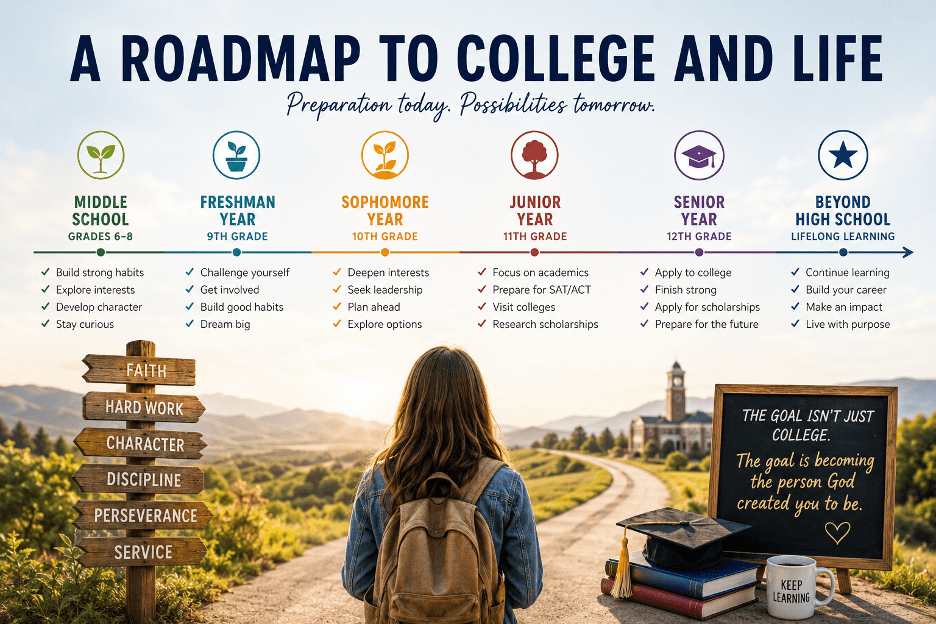
Middle School: Building the Foundation (Grades 6–8)
Middle school is often underestimated, but these years lay the groundwork for future success.
Parents should encourage:
- Daily reading
- Strong writing skills
- Mathematical confidence
- Scientific curiosity
- Public speaking opportunities
- Volunteer work
- Personal responsibility
- Healthy study habits
Students should also begin exploring interests without pressure. Music, robotics, sports, coding, art, entrepreneurship, debate, aviation, engineering, photography—the possibilities are endless.
Passion often begins with exposure.
Freshman Year (9th Grade): Establish Good Habits Early
Ninth grade sets the tone for high school.
Encourage your student to:
- Take challenging courses when appropriate.
- Develop consistent study habits.
- Join clubs or extracurricular activities.
- Begin volunteering in the community.
- Build healthy friendships.
- Explore career interests.
Admissions officers value consistency more than perfection.
Sophomore Year (10th Grade): Explore and Grow
Sophomore year is an ideal time to deepen interests.
Students should:
- Continue challenging coursework.
- Seek leadership opportunities.
- Consider dual enrollment or Advanced Placement courses if available.
- Begin researching colleges and careers.
- Continue community service.
- Strengthen writing and communication skills.
This is also a wonderful time to visit college campuses. Walking through a university can transform an abstract dream into a tangible goal.
Junior Year (11th Grade): The Most Important Academic Year
Many colleges consider junior year to be the strongest indicator of college readiness.
Students should focus on:
- Academic excellence.
- Leadership roles.
- SAT or ACT preparation.
- College visits.
- Building meaningful relationships with teachers and mentors for future recommendations.
- Beginning scholarship research.
Students interested in selective universities often begin taking the SAT during this year.
General score guidelines include:
- 1200+ – Competitive for many universities.
- 1300–1400 – Strong candidate for many colleges and merit scholarships.
- 1450+ – Highly competitive at many top universities.
- 1500+ – Competitive for many of the nation’s most selective institutions.
Remember, test scores are only one piece of the puzzle. Colleges also look closely at grades, course rigor, leadership, essays, service, and character.
Senior Year (12th Grade): Finish Strong
Senior year is about completing what has already been built.
Students should:
- Apply to colleges.
- Complete scholarship applications.
- Finish coursework with integrity.
- Continue leadership and service.
- Write thoughtful college essays.
- Stay engaged rather than “coasting.”
Many scholarships are awarded to students who continue demonstrating commitment until graduation.
What Prestigious Universities Really Want
Parents often ask, “What SAT score is good enough?”
The better question is:
“What kind of person is my child becoming?”
Selective colleges are looking for students who have demonstrated curiosity, resilience, leadership, initiative, and a willingness to contribute to something larger than themselves.
A perfect test score alone rarely secures admission.
Instead, colleges often look for students who have:
- Challenged themselves academically.
- Demonstrated leadership.
- Served their communities.
- Pursued meaningful interests.
- Overcome obstacles.
- Continued growing year after year.
Scholarships: More Than Just Test Scores
Many families assume scholarships are reserved for perfect students.
That simply isn’t true.
Scholarships are awarded for countless reasons, including:
- Academic achievement
- Community service
- Leadership
- Athletics
- Artistic ability
- Career interests
- Volunteer work
- Essay competitions
- Unique life experiences
- Specific majors
- Local organizations
- Cultural and civic involvement
Some students piece together several smaller scholarships that ultimately cover a significant portion of college expenses.
Never assume your child isn’t qualified.
Apply anyway.
What Parents Can Do Every Year
You don’t need to have all the answers.
Your greatest role is not to become your child’s admissions counselor.
Your role is to become their greatest source of encouragement.
Celebrate progress.
Read together.
Visit museums.
Watch documentaries.
Discuss current events.
Travel when possible.
Volunteer as a family.
Encourage curiosity.
Help your child discover not only what they are good at—but what they genuinely love.
Children who learn how to think critically and pursue knowledge with enthusiasm carry those habits into adulthood.
Success Is Not One-Size-Fits-All
Not every child will attend an Ivy League university.
Not every child should.
Success is not defined by the name on a diploma.
It is defined by whether a person discovers their gifts, develops them faithfully, and uses them to serve others while building a meaningful life.
Higher education takes many forms.
The goal isn’t simply college.
The goal is lifelong learning.
Final Encouragement
Parents, you matter more than you realize.
Your encouragement during difficult homework assignments…
Your conversations around the dinner table…
Your willingness to answer questions…
Your belief in your child’s potential…
These moments often shape a student’s future more profoundly than any standardized test.
Whether your child dreams of becoming a physician, engineer, entrepreneur, electrician, artist, pilot, teacher, or business owner, remember that every meaningful journey begins with someone believing they are capable of more.
Continue planting seeds.
Some will bloom quickly.
Others may take years.
But the investment you make in your child’s education today is one of the few gifts that can continue paying dividends for the rest of their life.
CALL TO ACTION
Need Personalized Guidance for Your Homeschool Journey?
If you’re looking for customized support in creating meaningful learning experiences, building strong family rhythms, or designing an educational plan that fits your child’s needs, I would love to help.
Visit HomeschoolUnleashed.com to explore consultations, one-on-one coaching, resources, and parent support services.
Together, we can make your homeschooling — and your family life — more joyful, confident, and connected.




Leave a Reply